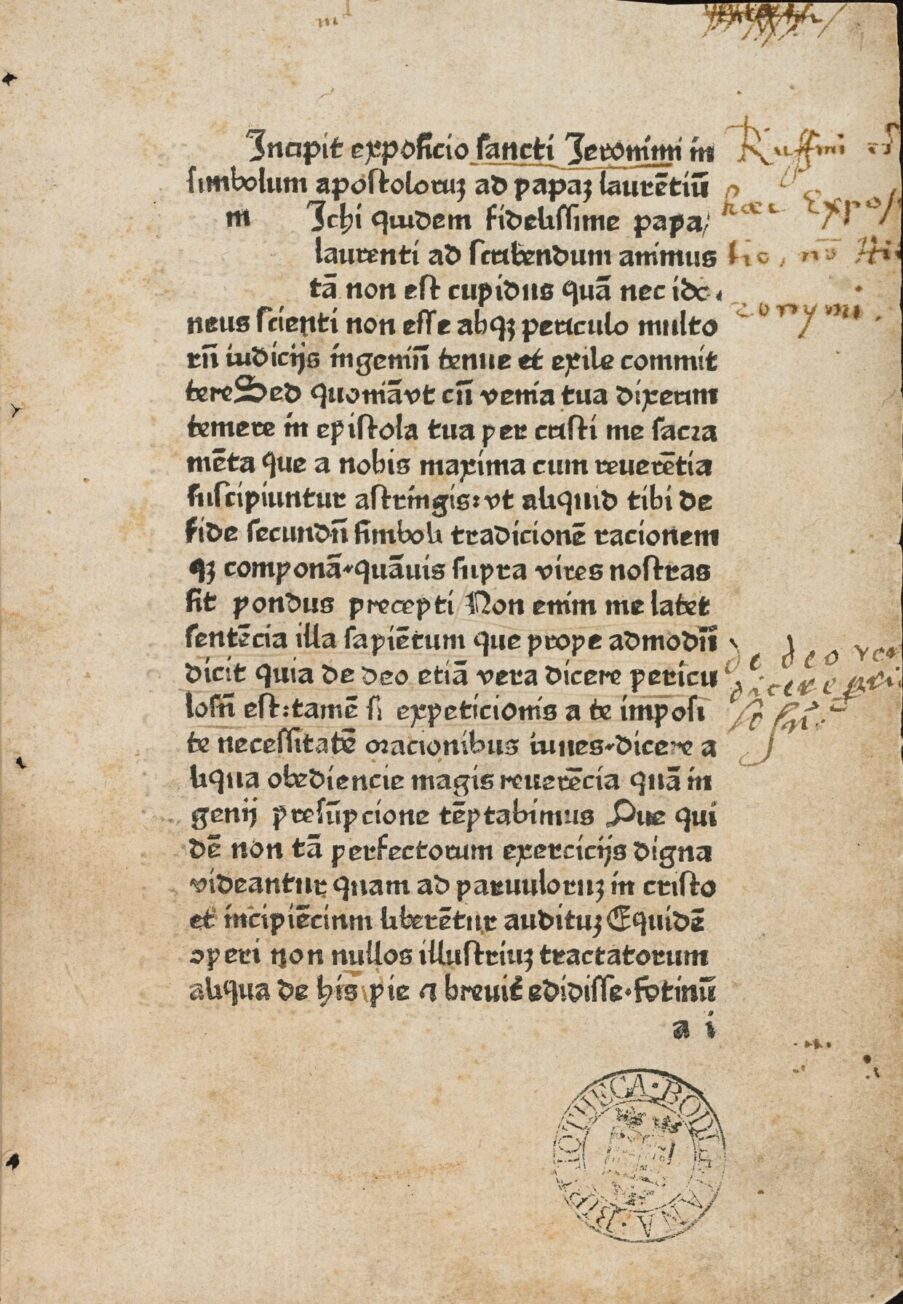
During the second reign of Edward IV, the first book is printed in Oxford, with the University’s support. This is the second place in England in which printing takes place, after William Caxton established a printing press in Westminster two years before. It is an exposition of the Apostles’ Creed, long attributed to Theodoric Rood, a printer from Cologne, but now believed to have been printed by another, unknown, printer from that city, with Rood’s known Oxford editions being issued during the 1480s.
1585
Joseph Barnes becomes the University’s first official printer. His print shop was on the High Street, potentially on the same site where the Press would open their depot in 1872.
1586
A Star Chamber document of Elizabeth I recognises the University’s legal right to employ printers.
1633
A group of academics, the Delegates of the Press, is established to supervise printing at the University. The Delegates are still an essential part of the Press’s governance to this day.
1636
The University Chancellor William Laud obtains the ‘Great Charter’ from Charles I, giving the University the right to print ‘all manner of books’.
1669
John Fell, Dean of Christ Church, and a Delegate of the Press, sets up the first central University print shop in the Sheldonian Theatre on Broad Street.
1675
The King James Version of the Bible and Prayer Book is printed at Oxford for the first time.
1692
The Stationers’ Company of London takes over the University’s lease to print bibles and prayer books.
1713
The print shop moves to the Clarendon Building on Broad Street, designed by Nicholas Hawskmoor. It was partly paid for with profits from Oxford’s printing of the History of the Great Rebellion by Lord Clarendon.
1755
Legal historian William Blackstone becomes a Delegate of the Press. He demands a reform of the business and calls for more scholarly printing.
1780
Shares in the Bible business are offered to outside printers to attract investment. This ‘partnership’ arrangement lasts until 1883.
1830
Oxford University Press moves to Walton Street in the suburb of Jericho, the current site of the Press.
1834
Thomas Combe is appointed to oversee learned book production. He subsequently takes on the role of Printer, and secures Wolvercote Paper Mill for the Press in 1855.
1869
The Secretary to the Delegates, Bartholomew Price, acquires a London bindery, and the Press begins publishing its printed work.
1874
Henry Frowde takes over as Manager of the London warehouse and develops it into the London office of the Press, known as Amen Corner. Frowde builds up London’s publishing list, including taking on the World’s Classics series, and becomes the first OUP Publisher.
1881
The Revised Version of the New Testament is published in conditions of great security; one million copies are dispatched from OUP’s London warehouse within 24 hours.
1884
The first part (or fascicle) of a New English Dictionary (later called the Oxford English Dictionary) is published, covering the range ‘a-ant’. The first edition of the OED is completed in 1928.
1896
The first office outside the UK is opened in New York. Offices in Canada, Australia, India, and South Africa follow before the First World War.
1906
The London office at Amen Corner is transformed into a publishing business under Charles Cannan, the Secretary to the Delegates, and his protege Humphrey Milford. Milford enters into a joint venture with the neighbouring Hodder & Stoughton to publish medical titles and children’s books. OUP’s first academic journal, The Quarterly Journal of Medicine, is also published.
1917
OUP acquires the Dictionary of National Biography.
1923
OUP’s Music Department is founded in London under Hubert Foss.
1924
The London business moves to Amen House, with a new warehouse in Neasden following a few years later. The London business closes in 1976.
1941
OUP begins printing top secret Allied naval code books as part of the war effort.
1948
A.S. Hornby’s Learner’s Dictionary of Current English (later called the Oxford Advanced Learner’s Dictionary) is published for learners of the English language. It is now the world’s bestselling advanced level dictionary for learners of English and one of OUP’s most successful titles.
1951
The Oxford Atlas is the first publication by OUP’s Cartographic Department
1978
The Press celebrates its quincentenary with events in the UK, America and all around the world. Wolvercote Paper Mill is leased to Brittains Ltd. – the mill is demolished in 2004.
1981
A new distribution depot opens in Corby, Northamptonshire, replacing the previous depot in Neasden, London.
1989
New technology and poor market conditions lead to the closure of the Printing House at Oxford, and the end of book printing at the Press. The Second edition of the Oxford English Dictionary is published.
1995
The Very Short Introduction series is launched, offering concise, expert-written books that provide introductions to a wide range of subjects.
2000
OED Online is launched, making the Oxford English Dictionary available online to subscribers.
2003
The New Grove Dictionary of Music and Musicians and The Grove Dictionary of Art are both acquired by the Press.
2004
The Oxford Dictionary of National Biography is published in sixty volumes, and is made available online to subscribers. Oxford Word of the Year is launched.
2011
OUP’s distribution centre moves to Kettering, Northamptonshire.
2013
OUP acquires Nelson Thornes, extending OUP’s range of educational publishing.
2020
A report on Words of an Unprecedented Year is issued, focusing on the change in language due to the COVID-19 pandemic.
2025
OUP signs a definitive agreement to acquire Karger, a health sciences publisher, expanding OUP’s Journals business.